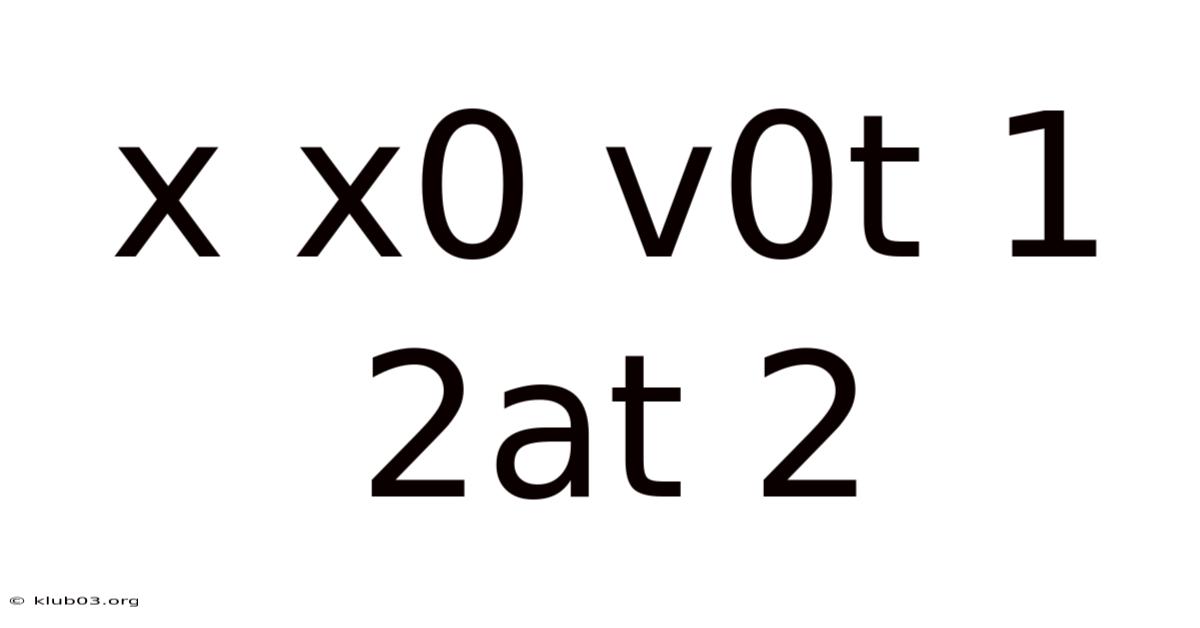
The kinematic equation x = x₀ + v₀t + ½at² is one of the most fundamental tools in classical mechanics. In real terms, it allows students, engineers, and physicists to predict the final position of an object moving with constant acceleration when the initial position, initial velocity, time, and acceleration are known. Often referred to as the second equation of motion, this formula bridges the gap between abstract theory and real-world motion, making it essential for anyone studying physics or engineering. Whether you are calculating how far a car travels while braking or determining the height of a projectile at a specific moment, mastering this equation provides a reliable framework for understanding displacement under uniform acceleration.
What Is the Kinematic Equation x = x₀ + v₀t + ½at²?
At its core, the equation describes the relationship between position and time for an object experiencing constant acceleration. Day to day, the left side, x, represents the final position of the object at time t. On the right side, x₀ is the starting position, v₀t accounts for the distance covered due to initial velocity, and ½at² captures the additional distance gained because of acceleration over time.
This formula belongs to a family of kinematic equations used when acceleration remains steady. Because of that, unlike average velocity formulas that assume constant speed, this equation recognizes that velocity changes linearly when acceleration is constant. Because of that, the position changes quadratically with time, which is why the t² term appears.
Breaking Down Each Variable
To use the equation confidently, you must understand what every symbol represents and how to measure it.
Initial Position (x₀)
This is where the object begins its motion. It can be zero if you define the starting point as the origin, or it can be any value depending on your coordinate system. Choosing a clear reference point is critical because all other positions are measured relative to it It's one of those things that adds up..
Initial Velocity (v₀)
This is the speed and direction of the object at t = 0. If the object starts from rest, v₀ equals zero. If it is already moving, v₀ carries that momentum into the calculation. The sign of v₀ matters: positive values indicate motion in the chosen positive direction, while negative values indicate motion in the opposite direction.
Time (t)
Time is the duration over which the motion occurs. It must be measured in seconds when using standard SI units. The equation assumes that t starts at zero when the object is at x₀ with velocity v₀ Nothing fancy..
Acceleration (a)
Acceleration is the rate at which velocity changes. In this equation, it must remain constant throughout the time interval. Positive acceleration speeds up an object in the positive direction, while negative acceleration (often called deceleration) slows it down or reverses its motion.
Final Position (x)
This is the result of the calculation. It tells you where the object is located after time t has elapsed, factoring in where it started, how fast it was going initially, and how its velocity changed due to acceleration.
How to Use the Equation: Step-by-Step Guide
Solving problems with x = x₀ + v₀t + ½at² becomes straightforward when you follow a consistent process.
- Identify the known variables. Write down x₀, v₀, a, and t based on the problem statement. If any value is missing, check whether another kinematic equation can help you find it first.
- Choose a coordinate system. Decide which direction is positive. Stick to this convention for every vector quantity, including velocity and acceleration.
- Convert units to SI. Ensure position is in meters, velocity in meters per second, acceleration in meters per second squared, and time in seconds.
- Substitute the values into the formula. Place each known quantity into its corresponding spot in the equation.
- Calculate the result. Follow the order of operations: square the time first, multiply by acceleration and one-half, add the product of initial velocity and time, then add the initial position.
- Interpret the answer. Check whether the final position makes physical sense. A negative result may simply mean the object ended up on the opposite side of the origin.
Example Calculation
Imagine a car starts at x₀ = 10 meters, travels with an initial velocity of v₀ = 15 m/s, and accelerates at a = 3 m/s² for t = 4 seconds.
Substituting into the equation:
x = 10 + (15 × 4) + ½(3 × 4²)
