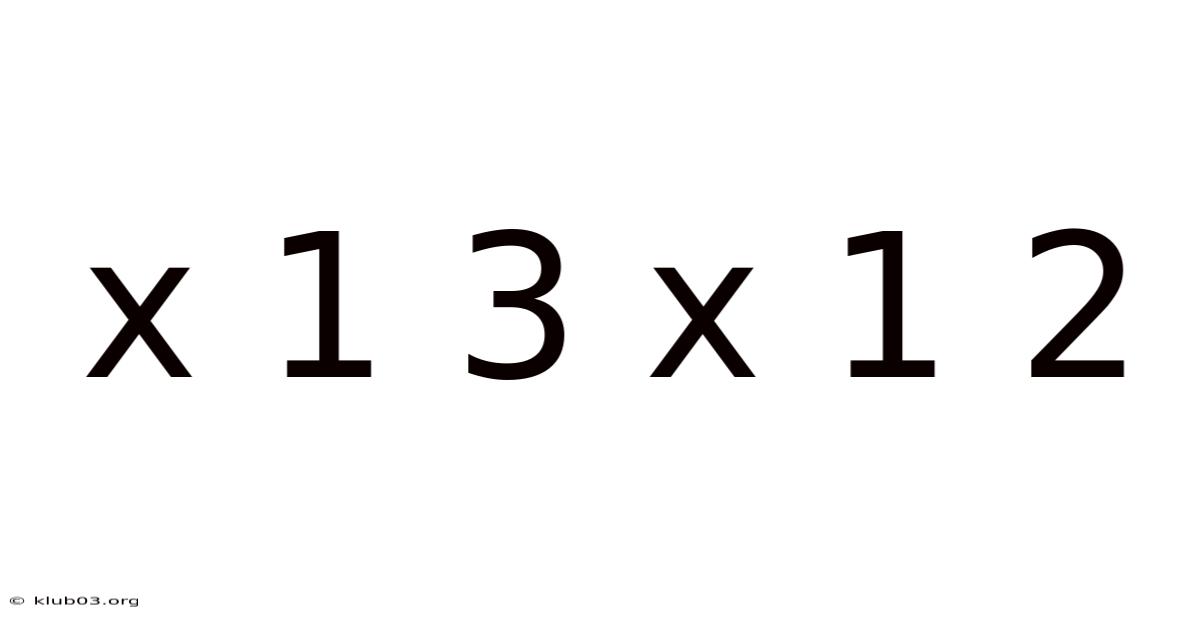
Understanding algebraic expressions involving variables and fractions is a fundamental skill in mathematics that opens doors to more advanced topics. When we encounter expressions like x × 1/3 × x × 1/2, we are looking at algebraic fractions that combine variables with numerical coefficients. These expressions appear frequently in algebra, calculus, physics, and engineering, making their mastery essential for students and professionals alike. This guide will walk you through the process of simplifying, manipulating, and applying such expressions in various mathematical contexts Surprisingly effective..
Breaking Down the Components
Before diving into simplification, it helps to understand what each part of the expression represents. In the expression x × 1/3 × x × 1/2, we have two variables (x) and two fractional coefficients (1/3 and 1/2). The variables represent unknown quantities that can change, while the fractions serve as multipliers that scale these variables Worth keeping that in mind..
When we write this expression more formally, it becomes:
x · (1/3) · x · (1/2)
or equivalently:
(1/3) · (1/2) · x · x
This rearrangement is possible because multiplication is both commutative and associative, meaning we can change the order and grouping of factors without changing the result Not complicated — just consistent. And it works..
Simplification Process
Simplifying expressions with variables and fractions follows a systematic approach. First, multiply the numerical coefficients together, then handle the variables separately.
For our example:
- Multiply the fractions: 1/3 × 1/2 = 1/6
- Multiply the variables: x × x = x²
- Combine the results: (1/6)x² or x²/6
The simplified form is x²/6 or (1/6)x². This process demonstrates how algebraic expressions become more manageable when we separate numerical operations from variable operations That's the part that actually makes a difference..
Operations with Algebraic Fractions
When working with more complex expressions, you may need to add, subtract, multiply, or divide algebraic fractions. Each operation has specific rules:
Multiplication: Multiply numerators together and denominators together, then simplify. For example: (2x/3) × (9/4x) = (2x × 9)/(3 × 4x) = 18x/12x = 3/2
Division: Multiply by the reciprocal of the divisor. For example: (x/2) ÷ (3x/4) = (x/2) × (4/3x) = 4x/6x = 2/3
Addition and Subtraction: Require common denominators. For example: x/3 + x/2 = 2x/6 + 3x/6 = 5x/6
Solving Equations with Fractional Coefficients
Expressions like x²/6 often appear in equations that need solving. Consider the equation:
x²/6 = 12
To solve for x:
- Multiply both sides by 6: x² = 72
- Take the square root: x = ±√72
This example shows how fractional coefficients affect the solving process and why understanding fraction operations is crucial for algebra success Practical, not theoretical..
Real-World Applications
Algebraic expressions with fractions appear in numerous practical situations:
- Cooking and Recipes: Adjusting ingredient quantities using fractional multipliers
- Construction: Calculating materials when dimensions involve fractions
- Finance: Computing interest rates and investment returns
- Physics: Formulas involving velocity, acceleration, and force often contain fractional coefficients
- Engineering: Stress calculations and material properties frequently use algebraic fractions
Understanding how to manipulate these expressions allows you to solve real problems efficiently and accurately.
Common Mistakes to Avoid
Students often make several errors when working with algebraic fractions:
- Forgetting to multiply coefficients and variables separately: Always handle numbers and letters in distinct steps
- Incorrectly adding fractions without common denominators: Remember that x/3 + x/2 ≠ 2x/5
- Dropping parentheses: When substituting values, use parentheses to avoid sign errors
- Ignoring domain restrictions: Variables cannot make denominators equal zero
- Misapplying exponent rules: x × x = x², not 2x
Advanced Techniques
As you progress, you'll encounter more complex expressions requiring additional techniques:
Factoring: Breaking down expressions like x²/6 - x/3 into x/6(x - 2)
Rationalizing denominators: Removing radicals from denominators in expressions like x/√
Advanced Techniques (Continued)
Rationalizing denominators: Removing radicals from denominators in expressions like x/√2 requires multiplying both numerator and denominator by √2, resulting in x√2/2. This technique becomes essential when dealing with complex algebraic fractions containing irrational terms It's one of those things that adds up..
Partial fraction decomposition: Breaking down complex rational expressions into simpler components. Take this case: decomposing (3x + 2)/(x² - x - 2) into A/(x - 2) + B/(x + 1) helps in integration and solving differential equations.
Complex fraction simplification: Handling fractions within fractions, such as (x/3)/(2x/5), requires multiplying by the reciprocal: (x/3) × (5/2x) = 5/6 No workaround needed..
Working with Multiple Variables
Algebraic fractions often involve multiple variables, requiring careful attention to like terms and common factors. Consider the expression:
(x²y)/(3z) × (9z²)/(xy) = (x²y × 9z²)/(3z × xy) = 9x²yz²/3xyz = 3xz/y
Notice how variables cancel appropriately, leaving only the necessary terms in the final result.
Checking Your Work
Always verify solutions by substituting back into the original equation. For the equation x²/6 = 12 with solution x = ±6√2:
(6√2)²/6 = 72/6 = 12 ✓
This verification step catches computational errors and confirms mathematical validity.
Conclusion
Mastering algebraic expressions with fractional coefficients forms a cornerstone of mathematical proficiency. Think about it: from basic operations to advanced techniques like partial fraction decomposition, these skills enable problem-solving across numerous disciplines. Success requires attention to detail, systematic approaches to operations, and consistent practice with verification methods. On the flip side, by understanding both the mechanics and applications of algebraic fractions, students develop the foundation necessary for advanced mathematics, scientific calculations, and real-world problem-solving. The key lies not just in memorizing procedures, but in comprehending why these methods work and when to apply them effectively And that's really what it comes down to..
