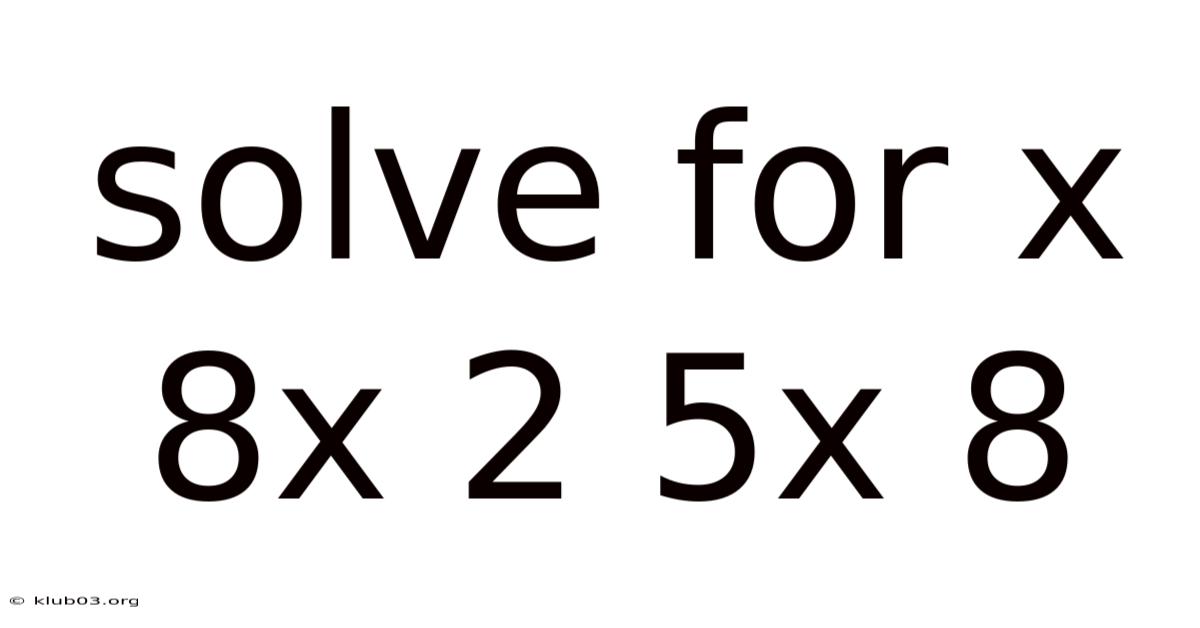
Solving Linear Equations: A Step‑by‑Step Guide Using the Example 8x + 2 = 5x + 8
Once you encounter an equation like 8x + 2 = 5x + 8, the goal is to solve for x—that is, to find the value of the unknown variable that makes the equation true. This type of equation is called a linear equation because the variable appears only to the first power, and its graph is a straight line. Consider this: mastering the technique of solving linear equations is a cornerstone of algebra and opens the door to more complex mathematical problems in fields ranging from physics to economics. In this article, we will walk through the process of solving for x using the concrete example 8x + 2 = 5x + 8, explain why each step works, highlight common pitfalls, and provide additional practice problems to reinforce your skills.
Understanding Linear Equations
A linear equation in one variable can generally be written in the form ax + b = cx + d, where a, b, c, and d are constants. The objective is to isolate the variable x on one side of the equation so that you can read its value directly. Think about it: the operations you use must preserve the equality—whatever you do to one side, you must also do to the other. This principle is rooted in the properties of equality: the addition/subtraction property and the multiplication/division property. By applying these properties systematically, you can transform a seemingly complicated equation into a simple statement like x = 2 Small thing, real impact. But it adds up..
People argue about this. Here's where I land on it.
Step‑by‑Step Solution for the Example 8x + 2 = 5x + 8
Below is a detailed breakdown of how to solve for x in the equation 8x + 2 = 5x + 8. Each step is explained so you understand not only what to do but why it works Worth knowing..
Step 1: Simplify Both Sides (if needed)
Before you start moving terms, check each side of the equation for like terms that can be combined. In our example, the left side 8x + 2 and the right side 5x + 8 are already in their simplest forms, so no simplification is required And it works..
Step 2: Move Variable Terms to One Side
The next goal is to gather all terms containing x on the same side of the equation. To do this, subtract 5x from both sides (using the subtraction property of equality). This eliminates the x term from the right side:
8x + 2 = 5x + 8
- 5x      - 5x
-----------
3x + 2 = 8
Now the equation reads 3x + 2 = 8. All x terms are on the left, and constants are on the right.
Step 3: Move Constant Terms to the Opposite Side
With the variable terms consolidated, the next step is to isolate the term that contains x. Subtract 2 from both sides to move the constant to the right:
3x + 2 = 8
- 2     - 2
---------
3x = 6
The equation now shows 3x = 6, meaning three times the unknown equals six Easy to understand, harder to ignore..
Step 4: Combine Like Terms (if necessary)
At this point, the left side already consists of a single term, 3x, and the right side is a single constant, 6. No further combination is needed.
Step 5: Solve for x by Dividing
To isolate x, divide both sides by 3 (the coefficient of x). This uses the division property of equality:
3x = 6
÷ 3   ÷ 3
----
x = 2
Thus, the solution is x = 2. You can verify this result by substituting x = 2 back into the original equation:
- Left side: 8(2) + 2 = 16 + 2 = 18
- Right side: 5(2) + 8 = 10 + 8 = 18
Both sides equal 18, confirming that x = 2 satisfies the equation.
Why This Method Works (Scientific Explanation)
The process described above is grounded in the properties of equality and the structure of linear equations. Here’s a deeper look at the underlying mathematics:
-
Addition/Subtraction Property of Equality – If a = b, then a + c = b + c and a − c = b − c. By subtracting the same term from both sides, we maintain the truth of the equation while reorganizing its components Which is the point..
-
Coefficient Isolation – A linear term ax represents a groups of x. Dividing both sides by a effectively asks, “How many groups of a are needed to reach the constant on the other side?” This yields the value of a single group, i.e., x.
-
Uniqueness of Solution – For a first‑degree (linear) equation with a non‑zero coefficient of x, there is exactly one solution. This is because the graph of the equation is a straight line that intersects the x‑axis at a single point Simple as that..
By following these logical steps, you are not merely memorizing a procedure; you are applying algebraic reasoning that ensures the solution is both correct and mathematically justified.
Common Mistakes to Avoid
Even after learning the steps, students often stumble. Being aware of these pitfalls can save time and prevent errors:
-
Forgetting to apply the operation to both sides – A frequent slip is subtracting 5x only from the left side. Always remember that any change to one side must be mirrored on the other to keep the equation balanced.
-
Incorrect sign handling – When moving terms across the equals sign, the sign changes. As an example, moving + 5x to the left becomes − 5x. Misplacing a sign leads to an incorrect coefficient.
-
Dividing by zero – Though not an issue in this example, always ensure you never divide by a variable that could be zero. In more complex equations, this can introduce extraneous solutions Practical, not theoretical..
-
Skipping verification – It’s easy to rush to
the final answer without checking. A quick substitution takes seconds and catches arithmetic or sign errors that would otherwise go unnoticed Worth knowing..
- Misidentifying like terms – Only terms with the exact same variable and exponent can be combined. Adding x to x² or treating a constant as a coefficient of x breaks the algebraic structure.
Extending the Technique: Equations with Fractions and Decimals
The same framework applies when coefficients are not whole numbers. Consider:
(1/2)x + 3 = (3/4)x - 1
-
Clear denominators (optional but efficient): Multiply every term by the least common denominator, 4.
2x + 12 = 3x - 4 -
Move variable terms: Subtract
2xfrom both sides.12 = x - 4 -
Move constants: Add 4 to both sides.
16 = x
The solution x = 16 checks out in the original equation. With decimals, multiply by a power of 10 to convert to integers, then proceed identically.
When the Variable Cancels Out
Occasionally, moving all variable terms to one side eliminates x entirely:
- True statement (e.g.,
5 = 5): The equation is an identity; every real number is a solution. - False statement (e.g.,
3 = 7): The equation is a contradiction; there is no solution.
Recognizing these outcomes is just as important as finding a numerical value Small thing, real impact..
Conclusion
Solving a linear equation is an exercise in logical equivalence: each step produces a new equation that has exactly the same solution set as the one before it. Practically speaking, verification then closes the loop, turning a procedural answer into a certified mathematical fact. And by systematically applying the properties of equality—adding, subtracting, multiplying, or dividing the same quantity on both sides—we peel away complexity until the variable stands alone. Mastering this process equips you not only for homework problems but for any discipline—physics, economics, engineering—where relationships between quantities must be untangled and quantified.
