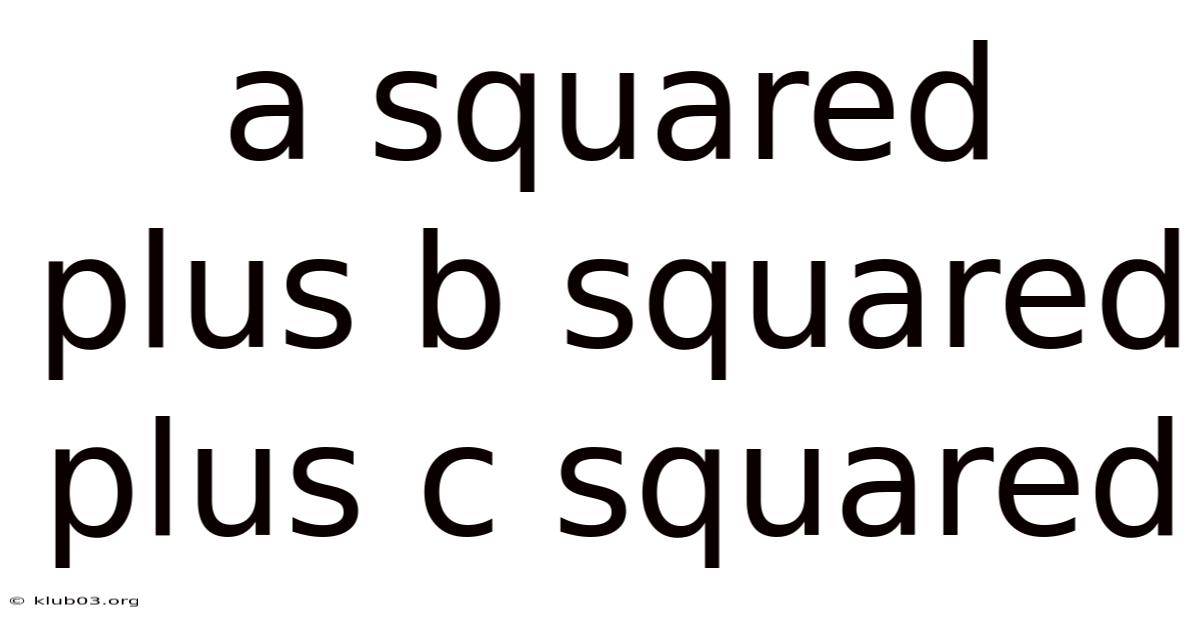
The expression a² + b² + c² appears in countless areas of mathematics, science, and engineering. At first glance it looks like a simple sum of three squares, yet its implications stretch from the geometry of right‑angled triangles to the measurement of error in statistical models. Understanding what this sum represents—and how it behaves under different transformations—provides a solid foundation for tackling problems in algebra, physics, data analysis, and beyond. This article explores the meaning, properties, and practical uses of a² + b² + c², offering clear explanations, illustrative examples, and step‑by‑step strategies that readers of any background can follow.
Mathematical Foundations
What Does a² + b² + c² Represent?
In its most basic form, a² + b² + c² is the sum of the squares of three real (or complex) numbers a, b, and c. Squaring each term eliminates any sign information, so the result is always non‑negative for real inputs:
[ a^2 + b^2 + c^2 \ge 0 \quad \text{for all } a,b,c \in \mathbb{R}. ]
When a, b, and c are viewed as the components of a vector v = (a, b, c) in three‑dimensional Euclidean space, the expression equals the square of the Euclidean norm (or length) of v:
[ | \mathbf{v} |_2^2 = a^2 + b^2 + c^2. ]
Thus, taking the square root gives the actual distance from the origin to the point (a, b, c):
[ | \mathbf{v} |_2 = \sqrt{a^2 + b^2 + c^2}. ]
Key Algebraic Identities
Several identities involve a² + b² + c² and are useful for simplification or proof:
-
Square of a sum
[ (a+b+c)^2 = a^2 + b^2 + c^2 + 2(ab + bc + ca). ] Rearranging yields
[ a^2 + b^2 + c^2 = (a+b+c)^2 - 2(ab+bc+ca). ] -
Relation to the sum of pairwise squares
[ (a-b)^2 + (b-c)^2 + (c-a)^2 = 2\bigl(a^2 + b^2 + c^2 - ab - bc - ca\bigr). ] -
Connection with the dot product
For two vectors u = (u₁, u₂, u₃) and v = (v₁, v₂, v₃),
[ \mathbf{u}\cdot\mathbf{v} = u_1v_1 + u_2v_2 + u_3v_3, ] and
[ |\mathbf{u}|_2^2 = u_1^2 + u_2^2 + u_3^2. ]
These identities frequently appear when manipulating expressions in algebra, calculus, and linear algebra Worth keeping that in mind..
Geometric Interpretation
From Pythagoras to Three Dimensions
The classic Pythagorean theorem states that for a right‑angled triangle with legs x and y and hypotenuse z:
[ x^2 + y^2 = z^2. ]
If we add a third leg w orthogonal to both x and y, we obtain a right‑angled tetrahedron (a 3‑D simplex). The distance from the origin to the opposite vertex is given by:
[ \text{Distance}^2 = x^2 + y^2 + w^2. ]
Thus, a² + b² + c² generalizes the Pythagorean theorem to three mutually perpendicular directions. In higher dimensions, the same pattern holds: the squared length of a vector equals the sum of the squares of its components Easy to understand, harder to ignore..
Relation to the Law of Cosines
For any triangle with side lengths a, b, c and angle γ opposite side c, the law of cosines reads:
[ c^2 = a^2 + b^2 - 2ab\cos\gamma. ]
Re‑arranging gives:
[ a^2 + b^2 + c^2 = 2\bigl(a^2 + b^2 - ab\cos\gamma\bigr). ]
When γ = 90°, the cosine term vanishes and we recover the Pythagorean relation a² + b² = c², showing how a² + b² + c² naturally extends the theorem to non‑right triangles Surprisingly effective..
Applications in Physics
Kinetic Energy of a Particle
In classical mechanics, the kinetic energy K of a particle of mass m moving with velocity components (vₓ, v_y, v_z) is:
[ K = \frac{1}{2}m(v_x^2 + v_y^2 + v_z^2) = \frac{1}{2}m|\mathbf{v}|_2^2. ]
Here the squared speed appears exactly as a sum of three squares, emphasizing that kinetic energy depends only on the magnitude of velocity, not its direction.
Moment of Inertia
For a point mass m located at coordinates (x, y, z) relative to an axis through the origin, the contribution to the moment of inertia about that axis is:
[ I = m(x^2 + y^2) \quad \text{(for rotation about the z‑axis)}. ]
If we consider the polar moment of inertia (resistance to torsion about the origin), it becomes:
[ J = m(x^2 + y^2 + z^2) = m|\mathbf{r}|_2^2. ]
Thus, a² + b² + c² quantifies how mass is distributed radially from a reference point But it adds up..
Electromagnetic Field Energy
The energy density u of an electromagnetic field in vacuum is given by:
[ u = \frac{\varepsilon_0}{2}E^2 + \frac{1}{2\mu_0}B^2, ]
where E and B are the magnitudes of the electric and magnetic field vectors. Each magnitude squared is a sum of three squared components, so the total energy density ultimately depends on expressions of the form a² + b² + c² for both E and B.
It sounds simple, but the gap is usually here The details matter here..
Role in Statistics and Data Science
Variance and Standard Deviation
For a data set {x₁, x₂, …, xₙ} with mean (\bar{x}), the variance is:
[ \sigma^2 = \frac{1}{n}\sum_{i=1}^{n}(x_i - \bar{x})^2. ]
Expanding the square yields
