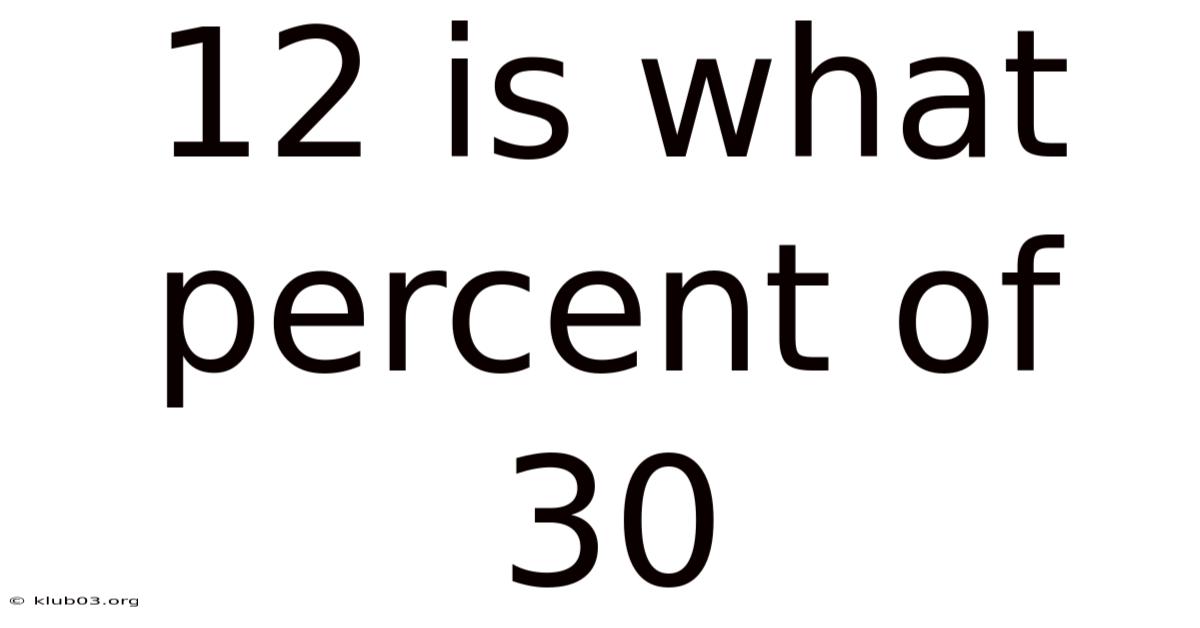
Understanding how to calculate percentages is a fundamental math skill used in everything from calculating discounts while shopping to analyzing data in professional reports. On the flip side, while the numerical answer is straightforward, the process of reaching that conclusion builds a critical foundation for numerical literacy. Even so, when faced with the question 12 is what percent of 30, the answer is 40%. This guide breaks down the calculation into simple steps, explores the underlying mathematical concepts, and provides real-world context to ensure you master this essential skill That alone is useful..
Some disagree here. Fair enough.
The Direct Answer and Basic Formula
Before diving into the methods, let’s establish the core relationship. A percentage is simply a fraction expressed as a part of 100. The word "percent" literally translates to "per hundred Most people skip this — try not to..
$ \text{Percentage} = \left( \frac{\text{Part}}{\text{Whole}} \right) \times 100 $
In the problem 12 is what percent of 30:
- The Part is 12.
- The Whole is 30.
Plugging these values into the formula: $ \left( \frac{12}{30} \right) \times 100 = 0.4 \times 100 = 40% $
That's why, 12 is 40% of 30.
Step-by-Step Calculation Methods
When it comes to this, three primary ways stand out. Choosing the method that clicks best with your learning style will make future percentage problems significantly easier.
Method 1: The Fraction Method (Standard Approach)
This is the most universally taught method in schools. It relies on converting the relationship into a fraction and then scaling it to a denominator of 100 Nothing fancy..
- Write the fraction: Place the "part" (12) over the "whole" (30). $ \frac{12}{30} $
- Simplify the fraction (Optional but recommended): Divide both numerator and denominator by their greatest common divisor (6). $ \frac{12 \div 6}{30 \div 6} = \frac{2}{5} $
- Convert to a decimal: Divide the numerator by the denominator. $ 2 \div 5 = 0.4 $
- Convert to a percentage: Multiply the decimal by 100 (move the decimal point two places to the right). $ 0.4 \times 100 = 40% $
Method 2: The Proportion Method (Cross-Multiplication)
This method is excellent for visual learners and for solving problems where the percentage is known, but the part or whole is missing. We set up a proportion where one ratio compares the part to the whole, and the other compares the unknown percentage ($x$) to 100.
$ \frac{12}{30} = \frac{x}{100} $
Steps:
- Cross-multiply: Multiply the numerator of the first fraction by the denominator of the second, and vice versa. $ 12 \times 100 = 30 \times x $ $ 1200 = 30x $
- Isolate $x$: Divide both sides by 30. $ x = \frac{1200}{30} $ $ x = 40 $
Method 3: Mental Math and Benchmark Percentages
For quick estimations or situations without a calculator, using benchmark percentages (10%, 25%, 50%, 75%) is incredibly powerful Simple, but easy to overlook..
- Find 10% of 30: Move the decimal point one place left. 10% = 3.
- Determine how many "10% blocks" fit into 12: Since $12 \div 3 = 4$, there are exactly four blocks of 10%.
- Calculate: $4 \times 10% = 40%$.
Alternatively, using 50% as a benchmark:
- 50% of 30 is 15 (half).
- 12 is less than 15, so the answer is less than 50%.
- 25% of 30 is 7.5 (half of 15).
- 12 is between 7.5 and 15, so the answer is between 25% and 50%.
- Since 12 is exactly $2/5$ of 30, and $2/5 = 40%$, the mental check confirms the result.
Why This Calculation Matters: Real-World Applications
Understanding that 12 is 40% of 30 isn't just an academic exercise. This specific ratio appears frequently in daily life.
Financial Literacy: Discounts and Savings
Imagine a store advertises a "$12 off" coupon on a $30 item.
- Instantly knowing this is a 40% discount helps you compare it against a "30% off" sale on a different brand.
- If you have a budget of $30 and spend $12 on lunch, you have spent 40% of your daily budget.
Academic Performance: Grades and Scores
- If a quiz has 30 questions and you answer 12 correctly, your score is 40%.
- If a class has 30 students and 12 are absent, the absentee rate is 40%. This data helps administrators plan resources.
Data Analysis and Business Metrics
- Conversion Rates: If a sales team makes 30 calls and closes 12 deals, their conversion rate is 40%.
- Market Share: If a market has 30 major competitors and your company holds 12 key accounts, you hold 40% of that specific segment.
- Project Management: If a project has 30 tasks and 12 are complete, the project is 40% done.
Health and Fitness
- Macro Tracking: If your daily carb limit is 30g and you eat 12g at breakfast, you have consumed 40% of your allowance.
- Heart Rate Zones: If your max heart rate reserve is 30 bpm above resting, and you are 12 bpm above resting, you are working at 40% intensity.
Common Mistakes and How to Avoid Them
Even simple percentage calculations are prone to specific errors. Being aware of these traps will improve your accuracy.
1. Reversing the Part and the Whole
The Mistake: Calculating $30 \div 12$ instead of $12 \div 30$ That's the part that actually makes a difference..
- $30 \div 12 = 2.5$ or 250%.
- This answers "30 is what percent of 12?", which is a completely different question. The Fix: Identify the "Whole" (the reference point, usually following the word "of") and the "Part" (the segment you are analyzing). The "Whole" always goes in the denominator.
2. Forgetting to Multiply by 100
The Mistake: Stopping at the decimal $0.4$ and writing the answer as 0.4% or just 0.4. The Fix: Remember the definition: Per Cent = Per 100. The decimal must be scaled up by a factor of 100 And that's really what it comes down to..
3. Incorrect Simplification
The Mistake: Simplifying $\frac{12}{30}$ to $\frac{1}{3}$ (dividing by
